
With terror and investments high on his agenda for talks with the UAE leadership, Prime Minister Narendra Modi on Sunday began his two-day trip to this strategic Gulf nation with a visit to the historic Sheikh Zayed Grand mosque, the world's third largest.

In a spontaneous outpouring of grief, thousands of people bid an emotional farewell to former President APJ Abdul Kalam who was on Thursday laid to rest with full state honours in his home town here amid chants of "Bharat Mata Ki Jai".

Fish-lover Rajesh Karkera revisits Taraporevala Aquarium V.20 after decades and comes back with mixed feelings. Is this the new-look one the city was promised?

'If the nub of India's sensitivity over the Chinese presence in Doklam is the enhanced threat to the Siliguri Corridor, a vital link to the northeast, does it serve the national purpose to have the districts along it, and then much of the tribal northeast, in turmoil?' asks Shekhar Gupta.

The 1971 war reaffirmed the importance of inspirational senior leadership in battle and heralded the emergence of a new fighting class amongst officers and men of India's armed forces.

'At that time the Delhi police was reeling under various controversies. This case was more of an attention diversion.'
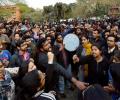
Do the students who chanted pro-separatist slogans and their teachers/supporters want the army to withdraw from Kashmir or not fight the terrorists?

Raghuram Rajan joked he wasn't expecting to win any votes or Facebook 'likes' in the position.
The new system will allow all government employees to mark their attendance from any central government department, by entering a six-digit unique number, besides finger prints or iris scan.

Aadhaar-related schemes and the Aadhaar Act exist on the assumption that Right to Privacy is not a Fundamental Right.

'Patel was more in tune with the popular mood than Jawaharlal Nehru. While the principle that Hindus and Muslims should be able to live together remained central to Nehru's vision for India, the Sardar was less sentimental.' 'Nehru would angrily face down mobs himself, rushing from trouble spot to trouble spot. A veritable tent city, filled with Muslim refugees, sprouted on the lawns of his bungalow... Mountbatten feared Nehru's impulsiveness would get him killed, and assigned soldiers to watch over him.' Nisid Hajari's Midnight's Furies: The Deadly Legacy of India's Partition casts fresh light on the events and personalities behind the horrific division of the subcontinent which haunts the India and Pakistan to this day.

News of all that's transpired on and off the football field

'Forensics experts say in all such unexplained deaths of scientists and engineers involved in the nuclear programme, fingerprints are absent, as also other clues that would assist the police in identifying the culprit(s).' Prasanna D Zore/Rediff.com reports on a petition that demands a Special Investigation Team probe the mysterious deaths of India's nuclear scientists.

'After many rudderless years, India and Japan have prime ministers with a sense of purpose and direction,' says Brahma Chellaney.

Rescue and relief operations continued in full swing in Chennai with over a hundred people taken to safety by teams of Army, IAF and NDRF, including a seven-month pregnant woman who was airlifted on Thursday from one of the worst-affected areas in the flooded city.

It is time to take the sainthood away from Dr Manmohan Singh, says Sudhir Bisht.

'It is highly doubtful that the Trump administration will consider inserting itself into the volatile India-Pakistan dispute.'

Water levels have started receding in Srinagar and telecommunication has been restored in parts of the city after it faced the worst floods in decades.

'For its part, Pakistan often gives safe haven to agents of chaos, violence, and terror.'

'The surge of Saudi nationalism is the last thing Washington wants,' says Ambassador M K Bhadrakumar.

Bangladesh's fundamentalist Jamaat-e-Islami chief Motiur Rahman Nizami was on Wednesday sentenced to death by a special tribunal for his role in the killing of thousands of people during the nation's independence war against Pakistan in 1971.

YSR Congress president Y S Jaganmohan Reddy has resigned as Kadapa MP in protest against "unilateral and arrogant posturing" of Congress party on the proposed division of Andhra Pradesh but stopped short of spelling out his party's stand on the statehood issue.

The State Department last week issued a worldwide travel alert warning Americans that Al Qaeda may be planning attacks in August, particularly in the Middle East.

Recalling her visit to Nairobi, Rediff.com's Anita Katyal speaks to immigrants she met on her trip, who say they are shaken by the incident but indomitable.

'When I read page number 50 of Transcendence, second paragraph, there he writes, "No more manoeuvres are required any more, as I am placed in my final position in eternity".' 'And within a month of that. he was no more.'

'India is no longer the India of the '70s and the '80s.' 'It's a large country with the fastest growing economy.' 'In working with India, you just can't go and humiliate the nation publicly.' USIBC President Mukesh Aghi tells Aziz Haniffa/Rediff.com about how he advises American companies to do business with India, what he thinks of Modi's government and the way forward for the India-US relationship.

The external affairs ministry's files, as distinct from those of the ministry of defence or the agencies, at least from before 1974 should be declassified. And if select files that are more than 40 years old are not to be declassified, the ministry should follow explicit guidelines to justify taking such a view, says Jaimini Bhagwat.

Vernon Gonsalves, who spent nearly six years in jail after being labelled a Naxalite by the security agencies, recounts in detail his arrest, the case against him and his future plans in an exclusive interview.

North Korea is unlikely to strike first, but its response in retaliation, if attacked, could be massive even at the expense of its own destruction, says Rajaram Panda.

'The army has stopped short of exerting the sort of influence it may have done historically.' 'It is comfortable with its relations with the civilian government as the superior partner.'

The step forward in marketing could be a move to bypass the media and towards owning it directly, says Ajit Balakrishnan.

'The civil war in Islam has just got worse and the existential crisis facing it more threatening.'

Meet Cassie de Pecol, a 27-year-old traveller from Connecticut, United States, who visited 196 countries in 18-and-a-half months, making her the fastest person to visit every country in the world.

'It's a humiliating time to be a human being.' It's a pity that the magnificent 17-year-old gorilla is dead. But it's not enough to hang our heads in shame or comfort ourselves with clicktivism, observes Bijoy Venugopal.

Finance minister tries to put house in order before reforms are unveiled in February.

J Sandhya, member, Child Rights Commission, speaks to Shobha Warrier about the recent incident where more than five hundred poor children from Jharkhand, Bihar and West Bengal were being sent to Kerala orphanages, and why children's rights need to be protected with vigour.

'Compared to other social groups, managing the Muslim constituency has always been easier for the secularists.' 'Just some symbolic measures and window-dressing would keep the Muslim flock together.' 'Having been betrayed by all the supposedly 'secular' political parties, Muslims should turn into citizens without any ascriptive identity marks,'says Mohammad Sajjad.

Amitabh Kant tells Rahul Jacob how India could be made an easier place to do business in and why India's software smarts will give it an edge.

'The summer of 1857 saw violence, perpetrated by the Indians and the Britons, on an unprecedented scale.' 'Never before and never after in the history of British rule in India was there violence at the level that 1857 witnessed.'

U R Ananthamurthy on the importance of keeping alive our regional languages.
